

Product Overview
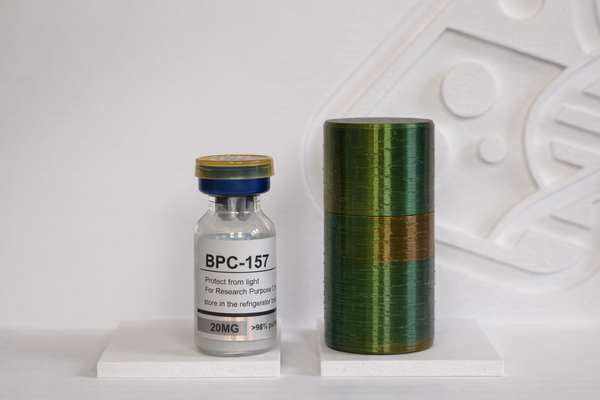
BPC‑157 – Research‑Grade Pentadecapeptide for Angiogenesis and Tissue‑Repair Pathway Investigation
Synonyms: Body Protection Compound‑157; PL 14736
CAS Number: 137525‑51‑0
Sequence: Gly‑Glu‑Pro‑Pro‑Pro‑Gly‑Lys‑Pro‑Ala‑Asp‑Asp‑Ala‑Gly‑Leu‑Val
Molecular Weight: Approx. 1,419 Da
Form: Lyophilised powder
Purity: ≥98% (HPLC)
Use: For laboratory research only. Not for human or veterinary use.
Overview
BPC‑157 is a synthetic Pentadecapeptide derived from a partial sequence of a naturally occurring gastric protein.
In research settings, it is widely used to investigate angiogenesis, cellular migration, and tissue‑repair‑related biochemical pathways in controlled laboratory models.
Its stability and broad mechanistic profile make it suitable for in vitro and non‑human in vivo studies examining wound‑healing processes, inflammatory responses, and cytoprotective signalling.
Mechanistic Insights
Preclinical research has explored BPC‑157 in relation to several biological processes:
• Angiogenesis Pathways – Studied for its potential influence on vascular growth and endothelial‑cell behaviour.
• Cell Migration and Tissue Repair – Investigated for its involvement in fibroblast activity, extracellular‑matrix interactions, and regenerative models.
• Inflammatory Modulation – Examined for its effects on cytokine‑related pathways in non‑human systems.
• Cytoprotective Signalling – Evaluated for its interaction with oxidative‑stress and cellular‑stability mechanisms.
These findings are based on published scientific literature and do not imply any therapeutic or physiological effects in humans.
Research Context
BPC‑157 is utilised exclusively within controlled laboratory environments for:
• Studies involving angiogenesis and vascular‑growth pathways
• Investigations into wound‑healing and tissue‑repair mechanisms
• Research on inflammatory responses and oxidative‑stress models
• Comparative studies with other regenerative or cytoprotective peptides
This material is not intended for therapeutic, diagnostic, or clinical use.
Packaging & Storage
• Supplied as a sterile‑filtered, lyophilised peptide
• Store at –20°C, protected from light and moisture
• Reconstitute under sterile laboratory conditions using bacteriostatic water or a suitable research‑grade diluent
• Store reconstituted solutions at 2–8°C and use according to institutional guidelines
Additional solubility and technical documentation are available to qualified research institutions upon request.
Compliance Notice
This product is intended solely for laboratory research purposes.
It is not approved for human or veterinary administration and must not be incorporated into food, cosmetics, pharmaceuticals, or any product intended for biological exposure.
All information provided is for scientific and educational reference only. Researchers are responsible for ensuring compliance with all applicable regulations, institutional policies, and safety standards.